
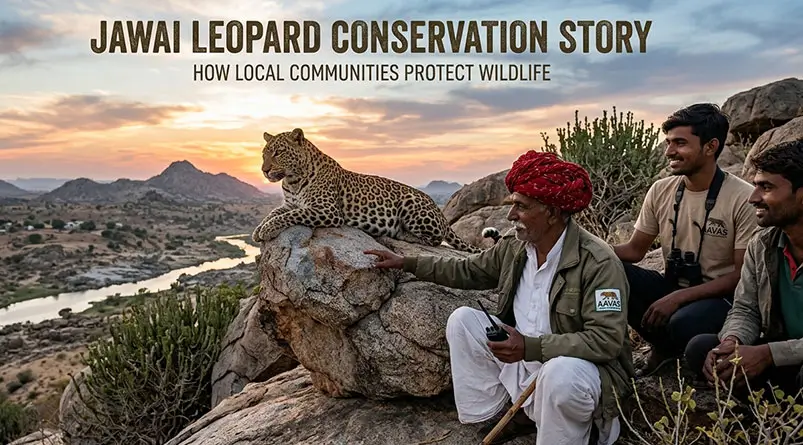
Rajasthan is often associated with majestic forts, desert landscapes and royal heritage, but the state also holds one of the most fascinating wildlife conservation stories in India. Hidden among the granite hills of the Pali district lies Jawai, a rugged landscape where humans and leopards have lived side by side for generations.
Unlike many wildlife reserves where animals live within fenced or protected areas, the Jawai leopard habitat in Rajasthan is an open landscape shared by villagers, shepherds and wildlife. In this extraordinary region, leopards roam freely among granite hills, while local communities continue their traditional lifestyles.
What makes Jawai unique is the remarkable relationship between the local Rabari community and the leopards. Instead of viewing these animals as threats, villagers have historically respected them as part of the natural environment.
Today Jawai has become internationally recognized for its conservation success and its ability to balance wildlife protection with rural livelihoods. Travelers visiting the region often describe Jawai leopard safaris as one of the most authentic wildlife experiences in India.
Understanding how this coexistence developed provides valuable insight into the future of wildlife conservation.
Jawai lies in a dramatic landscape of granite hills, rocky caves and open scrub forests. The terrain is very different from dense forests found in many national parks.
These rocky formations provide perfect shelter for leopards, which use natural caves and crevices as resting and breeding areas. Because the terrain offers excellent vantage points, leopards can observe their surroundings from elevated positions.
The Jawai Dam, built on the Jawai River, also plays an important role in the ecosystem. The water reservoir attracts a wide range of wildlife including crocodiles, migratory birds and prey animals that leopards depend on.
The combination of rocky hills, water sources and open landscapes makes Jawai one of the most suitable habitats for wild leopards in Rajasthan.
This environment allows visitors to observe wildlife in a natural setting rather than a heavily managed national park.
The Rabari community has lived in the Jawai region for centuries. These pastoral people traditionally raise livestock such as sheep, goats and camels while moving across the landscape in search of grazing areas.
Their culture is deeply connected to nature and local religious beliefs. Many Rabari traditions emphasize respect for animals and natural environments.
Interestingly, Rabari villagers have long tolerated the presence of leopards in nearby hills. While livestock losses occasionally occur, the community generally accepts these incidents as part of living within nature.
This attitude contrasts with many other regions where predators are often viewed as threats to be eliminated.
The Rabari belief system includes strong respect for local temples dedicated to regional deities. Some of these temples are located within the rocky hills where leopards also live.
Because these hills are considered sacred, human activity in leopard habitats remains limited, indirectly supporting wildlife conservation.
This cultural perspective has played a major role in preserving the Jawai leopard population.
From rocky hills and ancient caves to thrilling leopard sightings, Jawai offers an unforgettable wildlife experience.
Chat On WhatsApp Contact UsLeopards are highly adaptable animals capable of surviving in many environments, but Jawai offers several advantages that allow the species to thrive.
The rocky hills provide natural shelters that are difficult for humans to access, allowing leopards to rest and raise cubs safely.
The presence of prey animals such as wild boar, deer and small mammals ensures that leopards can find sufficient food.
Equally important is the tolerance shown by local communities. Because villagers rarely hunt or harm leopards, the animals have learned to coexist peacefully near human settlements.
This coexistence has allowed Jawai to become one of the best places in India for leopard sightings in the wild.
Wildlife photographers and nature enthusiasts travel from around the world hoping to observe these elusive animals in their natural habitat.
In recent years Jawai has gained international recognition as a unique wildlife destination. Safari operators now offer guided jeep tours into the hills where visitors can observe leopards from safe distances.
Unlike traditional tiger safaris where visitors follow strict park routes, Jawai safaris explore open landscapes guided by experienced trackers who understand leopard behavior.
Tourism has created new economic opportunities for local communities. Many Rabari villagers now work as guides, drivers or hospitality staff in eco-lodges.
This shift has encouraged communities to continue protecting wildlife because conservation directly supports their livelihoods.
Responsible tourism also helps raise awareness about the importance of protecting leopard habitats in Rajasthan.
Visitors who experience Jawai often leave with a deeper appreciation for wildlife conservation.
One of the most remarkable aspects of Jawai’s conservation success is that it exists without traditional protected park boundaries.
Unlike national parks surrounded by fences or strict entry gates, Jawai remains an open landscape where people and wildlife share the same territory.
This model demonstrates that wildlife conservation does not always require complete separation between humans and animals.
Instead, mutual respect, cultural traditions and responsible tourism can help create sustainable coexistence.
Conservationists often study Jawai as an example of community-based wildlife conservation in India.
The region shows that protecting predators can succeed when local communities feel respected and included in conservation efforts.
Jawai is more than a destination—it’s a living example of peaceful coexistence. Discover how culture and conservation come together to protect wildlife naturally.
Chat On WhatsApp Contact UsDespite its success, Jawai still faces several challenges. Increasing tourism must be carefully managed to ensure that wildlife habitats are not disturbed.
Unregulated development or excessive safari traffic could potentially affect leopard behavior.
Maintaining balance between tourism growth and environmental protection remains essential.
Local authorities and conservation groups continue working to promote responsible wildlife tourism practices.
Education and awareness programs also encourage visitors to respect the fragile desert ecosystem.
Protecting Jawai requires cooperation between communities, tour operators and conservation experts.
Jawai demonstrates that wildlife conservation can succeed through cooperation rather than conflict. The relationship between local communities and wildlife provides a powerful example of coexistence.
Instead of separating humans from nature, Jawai shows how traditional culture and environmental awareness can work together.
For travelers interested in wildlife, the region offers a rare opportunity to witness leopards living freely within a shared landscape.
This experience provides a deeper understanding of conservation challenges and solutions.
The story of Jawai continues to inspire conservationists and wildlife enthusiasts around the world.
Travelers visiting Jawai can explore the granite hills through guided safaris that search for leopards, birds and other wildlife species.
The region also offers beautiful rural landscapes, traditional villages and peaceful desert scenery.
Many travelers combine Jawai leopard safari tours with Rajasthan cultural itineraries, visiting nearby cities such as Udaipur and Jodhpur.
This combination allows visitors to experience both wildlife and royal heritage during their journey.
Rajasthan Tour Taxi provides private car and driver services for travelers visiting Jawai leopard safari region and wildlife destinations across Rajasthan.
Mr. Shakeer
? +91-9314165249
raj.tours.jp@gmail.com